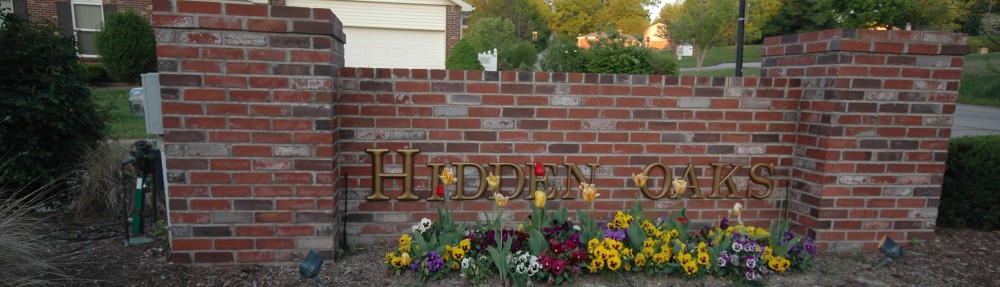
Hidden Oaks Annual Meeting – Board Member Needed
Please mark your calendars for Wednesday, April 16th at 6:30pm for the Annual Meeting. It will be held at the Police Station, as in years past. Josh Gentry has decided not to serve another term on the board, so we will need another home owner to volunteer to serve on the board this year.
If you can’t make it, please fill out the proxy ballot and give it to a neighbor that will be there. Last year, we did not have enough home owners attend, nor enough proxy ballots to reach a quorum, so we had to send out a mailing after the fact to conduct voting
Mayor Faith & Alderwoman Feldman have both agreed to speak to the group, so please let us know if there are any specific topics that you’d like either of them to address.
From the surveys that were filled out, here are some topics that we can discuss:
*speeding
*street parking
*parking across the sidewalk
*property upkeep – structures & lawn
*active neighborhood watch – can someone head this up?
Easter Egg Hunt
Karon Johannes has volunteered to bring back the Easter Egg Hunt this year, but she wants to gauge interest in having the event. Please let us, or her, know if you would like to see the event happen this year, and if you would have time to help pack the eggs with treats, or set up the day of the event. It will most likely be held on the Sunday before Easter in the afternoon.
Gateway Green Light
On behalf of your Councilwoman Laurie Feldman…as part of the Gateway Green Light Phase 1 project, contracted staff has implemented coordinated timing plans along Zumbehl Road and Muegge Road, with plans implemented along Fifth Street/South River Road last week. These include all signals along those routes, not just St. Charles City signals, in order to provide cross-jurisdictional coordination along priority arterials.
These new timing plans will provide great benefit to congestion experienced at signalized intersections, but there will likely also be some concerns from drivers as they begin to notice the change in operation.
· One negative side effect of coordinating the intersections for the major movement (i.e. northbound/southbound Zumbehl) is that the side streets (i.e. Dierberg’s driveways) may experience longer wait times until they get a green light. This is due to the plans locking in a certain amount of green time for the primary roadway. Drivers on side streets may be used to pulling up to an intersection, and if no vehicles were traveling on the primary road, they would get their turn within 7-10 seconds. That will usually not be the case when the coordinated plans are running during the AM and PM rush hours, and sometimes during mid-day and on weekends. It is important to note that the benefits of coordinated traffic signals are seen when you look at it from a roadway system-wide basis. The slight increase in time spent waiting on the side streets is extremely minor, when compared to the significant reduction in delay for the high number of drivers along the primary roadway.
· There is sometimes a perception that coordinated timing plans will mean that a driver will never need to stop at a signal along the route. While that is the goal, it is not very practical to expect, especially during times when the volume of vehicles simply is more than the route can handle. Drivers should expect better travel times along the coordinated routes, but not non-stop traffic flow. Also, if the driver accelerates quickly from a red light, and/or exceeds the speed limit between intersections, they are much more likely to need to stop again or slow down to wait for the green light at the next signal. We set the coordination plans based upon an assumed speed between the intersections, which is almost never more than the speed limit
 Hidden Oaks St. Charles